|
|
Lock-In Amplifiers
|
||
|
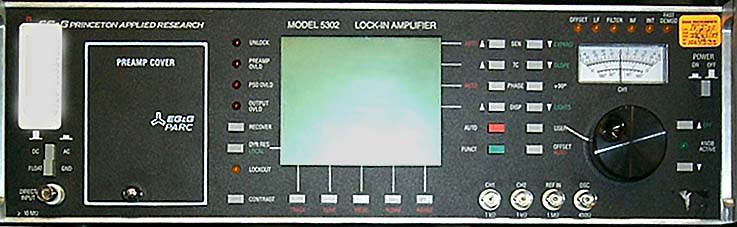
One of the biggest obstacles to overcome in the quest for accurate measurements is excess noise and interference that obstructs the signal from your sample. In other areas of this site, there are explanations of the many steps that can be taken during the experiment to reduce noise. Note, however, that the connections between the magnet and data acquisition devices are arranged to help reduce as much noise as possible. A central component of this arrangement is the Lock-In Amplifier. Lock-In Amplifiers detect the signal and any noise associated with it (including thermal, shot and 1/f noise). Because of this, it is necessary to take noise into consideration when choosing a frequency for the measurement. There is substantial 1/f noise at zero frequency, making DC undesirable. Measuring at a higher frequency usually results in a less noisy environment. However, if you go too high in frequency, cable capacitance and inductance may obscure the signal. Therefore, it is best to test your system at chosen frequencies to determine the appropriate one for your particular sample and measurement. Taking an
average of the signal is the first way to eliminate noise and
isolate the signal. Averaging over a time t enables you to measure
noise over a bandwidth ~1/t, no matter what the excitation frequency
is. The noise
Where Heterodyne
detection is when
It is important to know that the averaging time determines the bandwidth. This is crucial if the signal is changing. For example, if the signal varies at 100 Hz, then the averaging time has to be less than 10ms. Conversely, if there is an interference source at 60 Hz, and you want to measure at 200 Hz, while the signal varies at 10 Hz, then: If you choose a
filter time constant Then the filter bandwidth is
|
|||

















 you will see is
just
you will see is
just 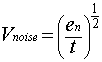
 is the
noise density at that frequency.
is the
noise density at that frequency. . This is
better.
. This is
better. . If
. If
 then
then then
then 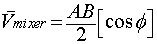
 of 50 ms for
averaging:
of 50 ms for
averaging: 